Research-Aid Networks is pleased to share a new study in JAMA Otolaryngology–Head & Neck Surgery evaluating a quick, low-cost way to screen for loss of smell. “A Novel Application-Based Test for Rapid Screening of Olfactory Dysfunction” was led by researchers at the University of California, San Diego, with Research-Aid Networks’ Jeremy Rossman contributing to the study’s concept and design.
Why smell matters
Loss of smell, known as olfactory dysfunction, affects about 22% of people. Most don’t know it. In one earlier study, about three out of four people whose testing showed smell loss had not noticed any problem.
That matters because smell does more than we realize. Smell loss can reduce appetite, contribute to poor nutrition, and make it harder to detect hazards like smoke or spoiled food. It is correlated with higher rates of illness and death. It can also be an early warning sign: it is one of the first symptoms of Alzheimer’s and Parkinson’s disease, yet more than 70% of people with these conditions are unaware their sense of smell has declined. During the COVID-19 pandemic, it also became widely recognized as a sign of infection.
Existing smell tests are often too costly or time-consuming for routine use. That leaves a gap for a tool that is simple and cheap enough to use widely.
How the test works
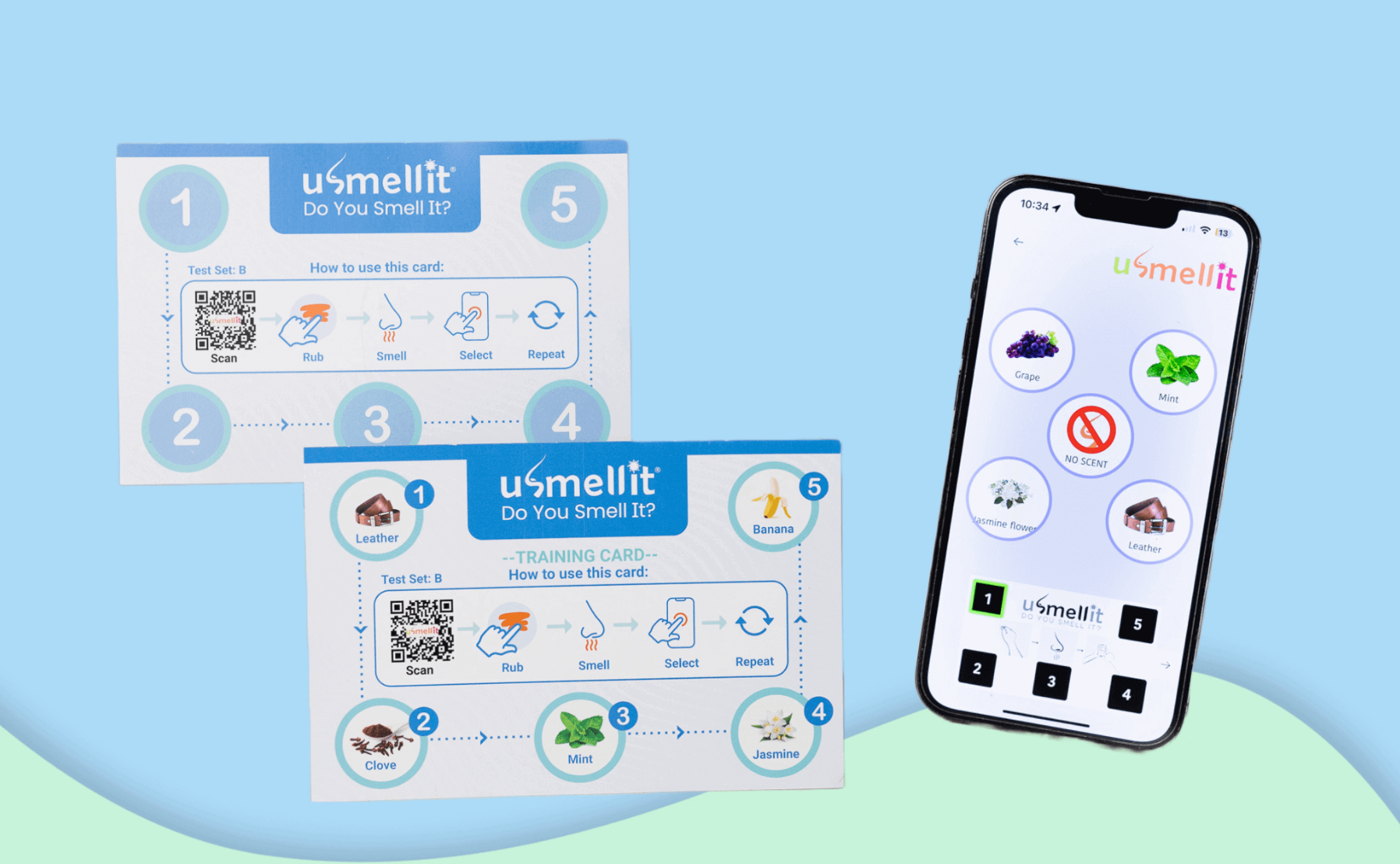
The study evaluated ‘U-Smell-It’, a self-administered test that uses five scratch-and-sniff scents, such as mint, rose, and clove. Each card has a QR code that opens a smartphone app. For each scent, the user picks the answer from five choices, including “no smell.” Scores range from 0 to 5, and results are saved automatically for clinical or research use.
What the study found
Researchers tested the tool with 484 adults at UC San Diego. Participants ranged from 18 to over 80 years old, and a third were 65 or older. Seventy-four participants (15%) said they had noticed smell loss.
The findings:
- The test took about two and a half minutes on average.
- People who reported smell loss scored about one point lower on average than those who did not (2.5 versus 3.5 out of 5).
- Sixty-two participants also took the Brief Smell Identification Test, a widely used clinical smell test. Scores on the two tests were strongly related. Using that test as the standard, the app correctly flagged about 3 in 4 people with smell loss (74%) and correctly cleared about 6 in 7 people without it (86%).
- Scores declined with age after 30, and women aged 18 to 29 scored higher than men the same age, both consistent with prior research on how smell changes across the population.
These are encouraging results for a two-minute test: it can quickly point to people who may benefit from a fuller evaluation, but it is not a diagnosis on its own.
What comes next
The comparison with the established test involved a fairly small group, and all participants were recruited at a single medical center. Some scents also proved harder to recognize than others: only 13% of participants correctly identified popcorn and 34% identified banana, compared with 75% to 84% for most other scents. Refining the scent selection, testing the tool in more places, and following people over time are the natural next steps.
Bernar, B. J., O. Baker, A. Pauley, C. J. He, V. Vo, D. Toomre, J. S. Rossman, and C. H. Yan. 2026. “A Novel Application-Based Test for Rapid Screening of Olfactory Dysfunction.” JAMA Otolaryngology–Head & Neck Surgery 152(3): 294–300. https://doi.org/10.1001/jamaoto.2025.4965
Disclosure: Co-author Derek Toomre is the founder, a major shareholder, and the patent holder of U-Smell-It LLC.