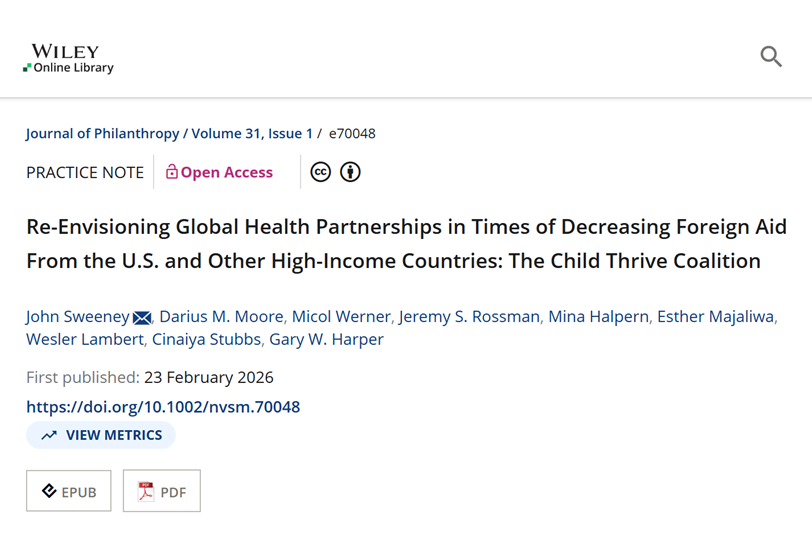
Research-Aid Networks is pleased to share a new open-access article on the Child Thrive Coalition, published in the Journal of Philanthropy.
“Re-Envisioning Global Health Partnerships in Times of Decreasing Foreign Aid From the U.S. and Other High-Income Countries: The Child Thrive Coalition” and written by Coalition partners, including Research-Aid Networks’ Dr Jeremy Rossman. Co-authors come from Children’s Place International, Children’s Place Association, the University of Michigan, Clínica de Familia La Romana, Kilimanjaro Christian Medical Centre and Zanmi Lasante.
A global health system under strain
We’re currently dealing with a hard reality. The United States has long been the largest funder of global health aid, and the dismantling of USAID in 2025 cut off a major source of support for health programs in low- and middle-income countries. Unfortunately, other high-income countries, including the U.K., France, Germany, and the European Union, have also reduced their foreign aid. Across all donors, global health aid fell by about 22% between 2024 and 2025. Children and adolescents are expected to bear much of the cost, through services lost for HIV, tuberculosis, maternal and child health, among others.
As damaging as this crisis is, we also believe that it is an opportunity for positive change. Traditional global health partnerships have often been top-down: whoever holds the money holds the decision-making power. As a result, programs can end up responding more to the funding environment and funder’s objectives than to what communities actually need. This can reduce the effectiveness of health aid while also promoting systemic inequities. As the global health system is rebuilt, there is a chance to build it more fairly.
The Child Thrive model
The paper presents the Child Thrive Coalition as one example of what a more equitable partnership can look like. The Coalition brings together five community health organizations in Haiti, the Dominican Republic, Tanzania, Kenya, and Chicago. Children’s Place International serves as an intermediary organization that connects them with donors, industry, and research partners. The model is grounded in Community Coalition Action Theory and differs from traditional partnerships in several ways:
- Communities lead. Member organizations decide which projects to develop, and they have a say, including veto power, over which donors the Coalition engages.
- Communities set the measures of success. Members choose the evaluation metrics that matter for their own projects and decide how data should be collected.
- Members learn from each other. Organizations working on similar problems in the same region are paired in dyads. Current dyads are HIV service providers in Hispaniola and sickle cell and pediatric cancer providers in East Africa.
- Care goes beyond the clinic. Projects address treatment, prevention, social determinants of health, and education and career readiness, so that they reach both the immediate health needs of children and the structural conditions that keep families in poverty.
- Donors are asked to listen. Donors visiting project sites are first trained in equity and cultural humility and encouraged to listen to communities.
A five-step framework guides each project, from identifying a population in need through funding, planning, implementation, and feedback. Community organizations take part in every step.
Research-Aid Networks’ role
Within the Coalition, Research-Aid Networks supports research design, implementation, publication, and communication, making sure community organizations are engaged and involved at every step. This publication reflects that approach: it was written jointly by the community organizations, the intermediary, and research partners.
Building the evidence in Haiti
The article also relates to one of our current projects. Working with Children’s Place International and Zanmi Lasante, Research-Aid Networks is carrying out an in-depth analysis of programmatic data to understand the impact of their educational support program in Haiti. The program works in multiple regions within Haiti to help children and adolescents advance through their educational journey and build the capacity to earn a living wage. It combines access to healthcare, support for a stable home environment, and financial and professional development support for continued education.
The findings will be shared across the Coalition so that partners in other countries can learn from Children’s Place International and Zanmi Lasante’s experience. This is the kind of community-owned evidence the Child Thrive model is designed to produce and share.